
Hollister City Directory Shelf Map
Hollister city directory evidence sits with several custodians. The chart separates confirmed coverage from leads that still need local inspection. A missing year is no reason to guess a publisher or trust a reseller listing.
| Collection | Years | Where Held | Access |
|---|---|---|---|
| Hollister and San Benito business directories | Exact titles, publishers, and year runs not published online | San Benito County Historical Society Research Center, 498 Fifth Street | Appointment and staff-mediated research |
| City, telephone, reverse, and criss-cross directories | Not yet verified locally; no reliable run disclosed | San Benito County Free Library and Historical Society | Ask reference staff to inspect local or uncataloged shelves |
| Great Registers | Years are not itemized online | Historical Society Research Center | Appointment; historical voter and residence evidence |
| Tax assessment rolls | Years are not itemized online | Historical Society Research Center | Appointment; taxpayer and property evidence |
| California and Local History Collection | Developed and expanded from 1979 onward | San Benito County Free Library, 470 Fifth Street | On-site reference help; public catalog search |
| Hollister Sanborn maps | August 1886, May 1892, December 1902, October 1910 | Library of Congress Geography and Map Division | Free digital sheets; buildings and uses, not names |
| Federal population census | 1880-1950 public schedules; 1890 loss applies nationally | NARA, FamilySearch, and library databases | Public through 1950 under the 72-year rule |
| San Benito probate records | Indexes 1874-1920; registers and fee books 1874-1969 | FamilySearch Catalog 697117 and Hollister FamilySearch Center | Some images may require center access |
Think of this as a coverage map. Not every row holds a Hollister city directory. The Historical Society finding aid names business directories but skips exact titles and years. The library catalog searches freely without a login. Even so, it publishes no dependable Hollister city-directory, telephone-book, reverse-directory, obituary-index, microfilm, Ancestry, or HeritageQuest run. Before citing any edition, ask for its title page, publisher, year, format, and access terms.
Hollister City Directory Library Trail
The San Benito County Free Library at 470 Fifth Street is the practical first stop for local-history reference help. Its California and Local History collection grew from work begun in 1979 and expanded after that. The catalog searches without a login. An account only unlocks patron functions. A hit can identify a book, but a null result proves nothing about a local directory, telephone book, or microfilm item.
The library's own story adds context. Hollister had a public library in 1884. A $10,000 Carnegie grant completed the 1911 building, now City Hall at 375 Fifth Street. That story spans three sites. The county library began February 4, 1917. City and county libraries consolidated on September 12, 1960, at the present Fifth Street site. In 1947 the collection received Charles E. Pressley's original manuscript of Romance Del Rancho San Justo.
The library history record helps place a Hollister city directory request in the right institutional setting. The record is brief but useful. And the library history page shows the long local-history line behind the Fifth Street collection.
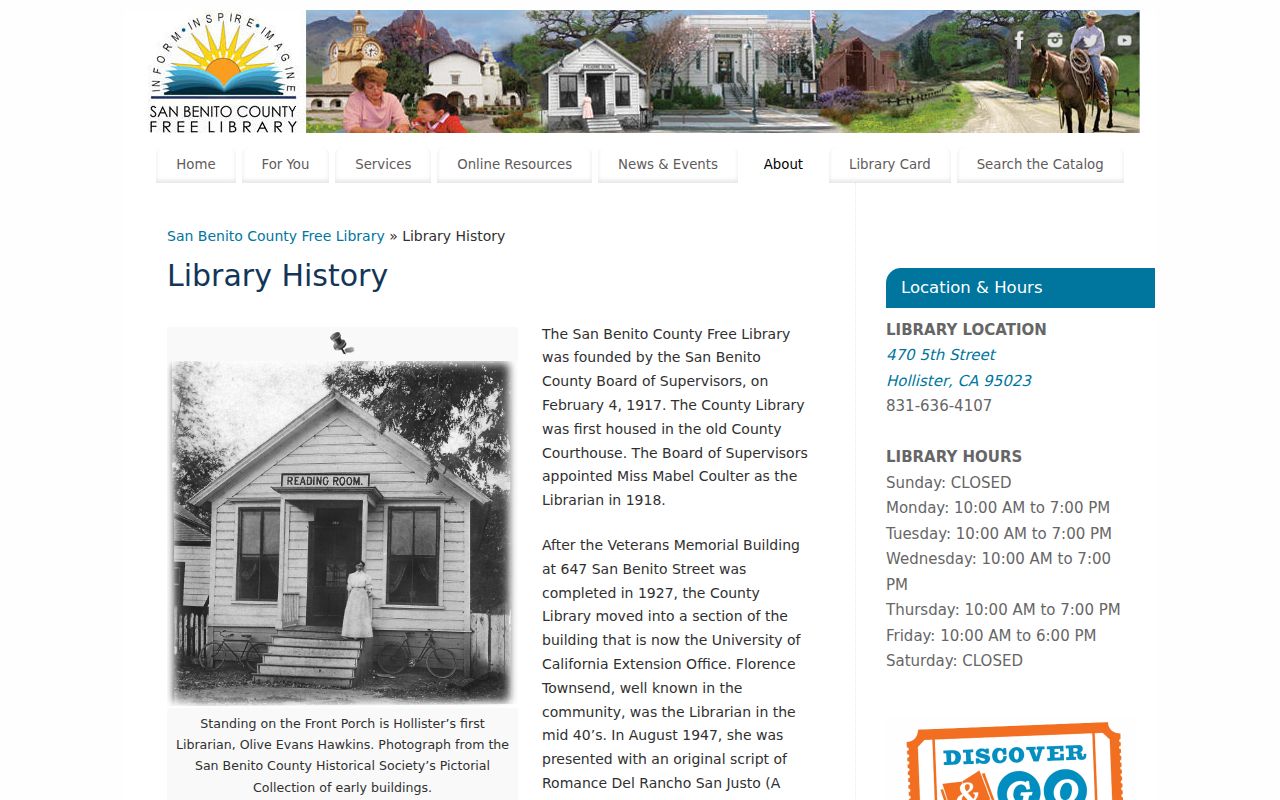
A historical collection always has a custodian. This image is a reminder of that. Call (831) 636-4107, or ask reference staff to check the exact volume rather than assuming the library held a common directory series.
Which Hollister City Directory Years Count?
No authoritative Hollister resident city-directory page is openly digitized. The two main local custodians publish no scan or item-level finding aid establishing a complete year run. Exact titles, publishers, and years remain a real gap. A careful citation should state what was inspected, where it was held, and what the title page confirms.
That gap corrects a common myth. A city directory is not a full resident roll. Business directories favor proprietors and business addresses. A Great Register is voter evidence, not a household list. An assessment roll points to a taxpayer or property interest. A census can miss a move between enumerations. Even a volume labeled city directory may skip children, the unlisted, or households outside the publisher's scope.
Local verification rule. Treat common directory conventions as inspection targets only. Do not present spouse, occupation, owner marks, widow notation, or a reverse section as a confirmed Hollister field until staff verifies the actual volume.
Ask a better question instead. Not "What year run should be here?" Ask "Which Hollister volume can the library or Society identify, and what does that edition show?" That wording protects your work from false certainty. A catalog gap, read the wrong way, turns quickly into invented coverage. Note: A person absent from a business directory may have been a child, farmer, homemaker, or simply outside that edition's scope.
How Hollister City Directory Entries Read
No verified local sample entry exists yet to quote. The inventory below lists what to look for when a real Hollister city directory comes off the shelf. These are common conventions, not confirmed fields in a Hollister volume. Photograph the title page first. Transcribe the abbreviation key before interpreting any short mark.
| Surname and given name | Not yet verified locally; check initials, spelling variants, and the order used by the edition. |
|---|---|
| Spouse or widow notation | Common convention, not yet verified locally; parentheses or a widow abbreviation need the volume's key. |
| Occupation or business address | Inspection target only; do not assume every adult or business detail appears. |
| Home address | Look for a street line, but do not assume a reverse section exists. |
| Owner or renter mark | Not yet verified locally; symbols vary and may not occur in a given run. |
| Street or reverse section | Must be confirmed in the actual volume before an address-to-occupant search is promised. |
- Criss-cross directory
- An address-order section that can point from a street and number toward a listed name, if the edition includes one.
- Householder index
- A name-centered list of heads of households or listed occupants; it is not automatically a list of every person at an address.
- Abbreviation key
- The publisher's explanation of short forms and symbols. Its placement and meaning must be read from the local volume.
Hollister City Directory Files at Wapple House
The San Benito County Historical Society Research Center sits at Wapple House, 498 Fifth Street. It is the deeper local-history channel. Its online holdings list business directories, Great Registers, tax assessment rolls, and county newspapers. Family and People Files with obituaries, yearbooks, cemetery records, maps, diaries, and photographs round out the list. Dates are not itemized online. Even so, these collections can supply names and context around a city directory gap.
Research runs by appointment with staff help. The Society normally schedules in-person research by email for the second Monday of the month. Members pay $10 an hour for remote volunteer research. Nonmembers pay $15. Expect a two-to-three-month backlog. Letter-size black and white copies cost $0.25. Letter-size color runs $0.50. Oversized copies are also $0.50.
The Wapple House museum page places the archive in its historic Fifth Street setting.
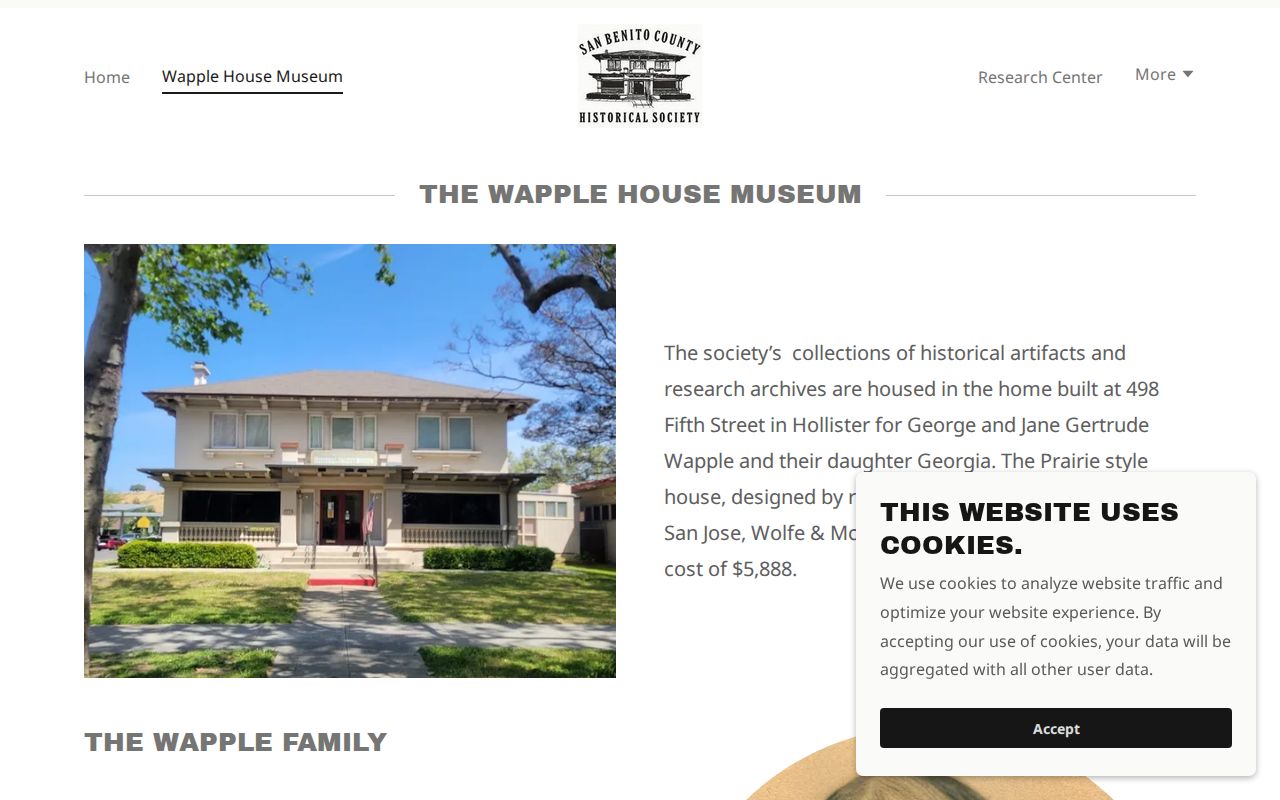
Anyone using the Hollister residents directory files at Wapple House signs in first. Requests for materials go through staff. Pencil or a laptop is fine; pens are not. Readers do not reshelve items themselves. Newspaper articles can usually be photographed without a fee. Staff have discretion, though. Society photographs go through a separate image-order and use process. When you send a request, include the names, dates, relationships, and sources you have already checked. That detail lets staff test the right file. It keeps them from guessing at the residents directory boxes.
Hollister City Directory Probate Bridge
FamilySearch will never replace a Hollister city directory. It can still explain a sudden change in a household or property trail. The street directory leaves those moments blank. Catalog 697117 holds San Benito probate indexes covering 1874 through 1920. It also carries registers and fee books that reach 1969. A register entry can give you an action number. It may also give the estate or guardianship name, an executor, an administrator, a guardian, and a cross-reference to an original register and folio.
All six filmed reels have been digitized. Some images still require a login or a visit to a FamilySearch Center. The local center sits at 1670 Cienega Road in Hollister, (831) 207-4030. Call ahead to confirm hours. Probate matters most when a past resident of Hollister died, left an estate, or passed property to an heir. It cannot prove that everyone named in a file shared one address. So treat it as a neighbor record, not a resident lookup.
The Hollister FamilySearch Center listing identifies the local access point for restricted images.
The center can bridge an indexed probate clue to the actual image or catalog detail. Keep the catalog number, reel information, and the source of every name in your notes. That habit keeps a probate lead from being mistaken for a city directory entry.
Four Hollister Directory Map Snapshots
The Library of Congress holds four Hollister Sanborn editions: August 1886, May 1892, December 1902, and October 1910. The 1886 Hollister Sanborn item opens the sequence. Later sheets sit nearby as related items. The maps chart buildings, uses, street widths, property boundaries, house and block numbers, water mains, and fire infrastructure.
Sanborn maps never name residents. Their worth is address context. A footprint that appears, changes use, or gains a new number can align a directory clue with the right block in Hollister. Before assigning any person to a building, pair the map with a deed, an assessment roll, a census line, a newspaper notice, or a Society file.
These sheets also guard against false continuity. An old street label or building number may not match a modern search. The map can show that a structure changed before a name shows up in a later source. It dates the built setting, never the household.
Trace a Hollister City Directory Household
Family-history searching in Hollister works best when it is anchored to a second source. Every directory clue deserves that backup. Start with one known person, an approximate date, or an address. Write down the exact spelling and initials. Note the spouse or family link, occupation, street line, and any symbol. If a volume is not confirmed, ask staff for help. They can point you to the nearest business directory, Great Register, assessment roll, newspaper, or yearbook. A blank in one residents directory is not a missing person.
- Find the first confirmed appearance and transcribe the title page, publisher, edition year, page, and abbreviation key.
- Follow the name across available editions, noting spelling changes, address changes, marriage or widow notation, and gaps.
- Check a street or criss-cross section only if the local volume confirms one, then compare the block with a Sanborn sheet.
- Pair the directory date with the nearest census, Great Register, assessment roll, deed, yearbook, or newspaper evidence.
- Close the trail with an obituary, cemetery record, or probate index, and label each conclusion by its source.
A name can drop out of a city directory for many reasons. Death, a move, retirement, a missed edition, a shift in listing policy, or ineligibility for that volume all look the same on the page. When your question centers on one address and its title history rather than the collection, the Hollister past-residents trail fits better.
Pair Hollister City Directories With 1950
Federal census schedules offer a household-level check that a street directory rarely can. San Benito County schedules from 1880 through 1950 are open at public repositories under the 72-year release rule. That rule makes 1950 the newest public census year. The 1890 population schedules were largely destroyed nationwide. So a gap there is not a Hollister publishing failure.
Treat a census name result as a starting point. Then browse the whole enumeration district and the nearby lines. An enumeration district is simply the area assigned to one census taker. Neighbors, ages, relationships, and occupations all help. The recorded address can separate two Hollister residents who share a name. A census still captures one date, not continuous occupancy.
A city directory year may fall between censuses. Compare the address and household pattern on both sides. A stable street and family link strengthens your inference. It still cannot turn an unverified directory year into a fact.
Hollister City Library Timeline
The library's own story explains why Hollister city directory research now crosses buildings, agencies, and collections. These dates mark institutional anchors, not directory publication years.
| 1884 | Hollister public library was instituted. |
|---|---|
| 1911 | The Carnegie library building was completed with a $10,000 grant; it is now City Hall at 375 Fifth Street. |
| February 4, 1917 | San Benito County Free Library was founded and began in the old courthouse. |
| 1927 | The county library moved into the Veterans Memorial Building after its completion. |
| 1947 | Florence Townsend received Charles E. Pressley's original Romance Del Rancho San Justo manuscript for the historical collection. |
| September 12, 1960 | City and county libraries consolidated at 470 Fifth Street. |
| 1979 onward | The California and Local History collection was developed and expanded. |
That layered history is the insider angle. A question about a name, a street, or an old volume may begin in the public catalog, then move to reference staff. From there it can require the Society, FamilySearch, or a federal census source.
Fill Hollister City Directory Gaps Carefully
A missing Hollister edition is not the end of the trail. Surrounding records can fill the gap. Treat them as evidence, not as a directory. Great Registers carry voter and residence clues from earlier decades. Tax assessment rolls can name an owner or taxpayer. A newspaper item or an obituary often adds a person to a year. A Family and People File can do the same. Yearbooks tie a former classmate to a school. Cemetery records can confirm a death or a family grouping.
Know each source's limits. A business directory skips most households. A Great Register is no census. A tax roll names a taxpayer, not the occupant of a parcel. A Sanborn sheet shows buildings, not people. A 1950 census line proves nothing about a later address. Real strength comes when several Hollister records agree, not when one book has many fields.
Best request language. Ask the library or Society to verify a title, publisher, year, volume format, reverse section, and abbreviation key, and state which nearby records have already been checked.
Handled this way, Hollister city directory work stays honest. A guessed publisher or an unlisted year never becomes a fact. The county's history and genealogy web portal points toward cemetery and newspaper material. It also covers Historical Society and FamilySearch resources. The next step is simple. Walk to the shelf, note the title page, and cite the custodian.